
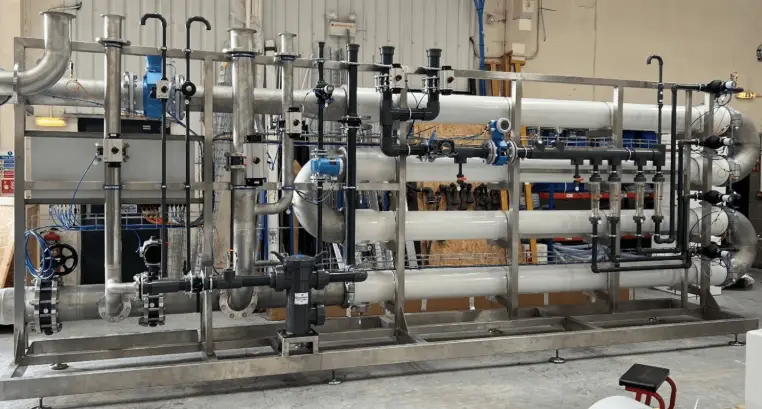
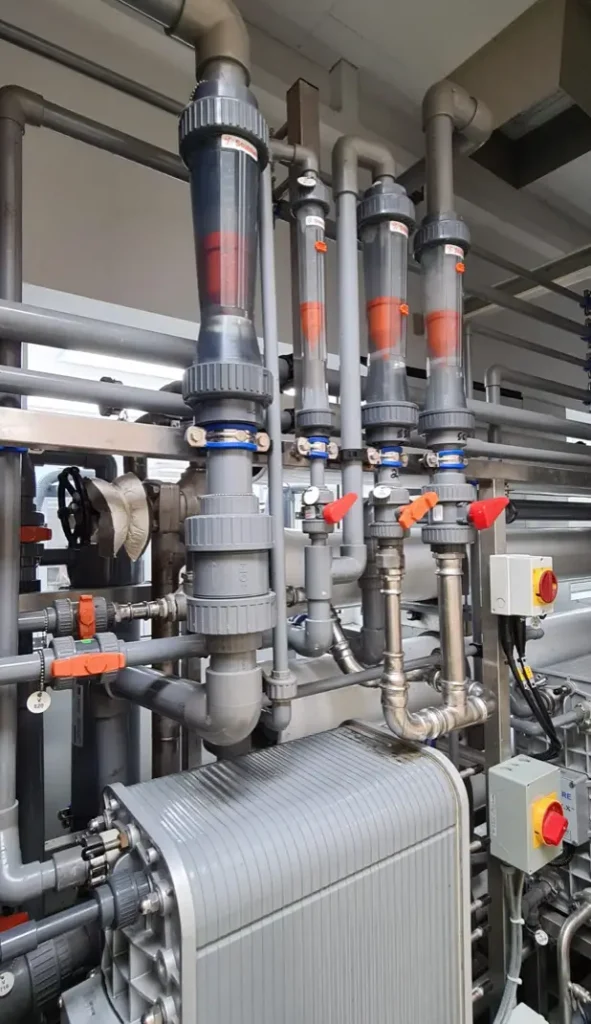
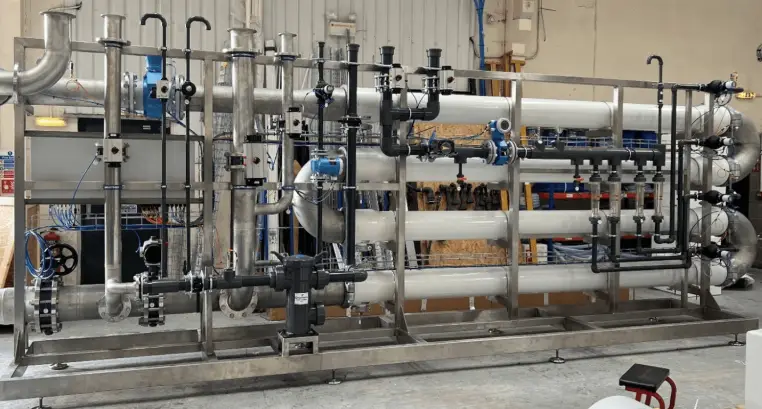
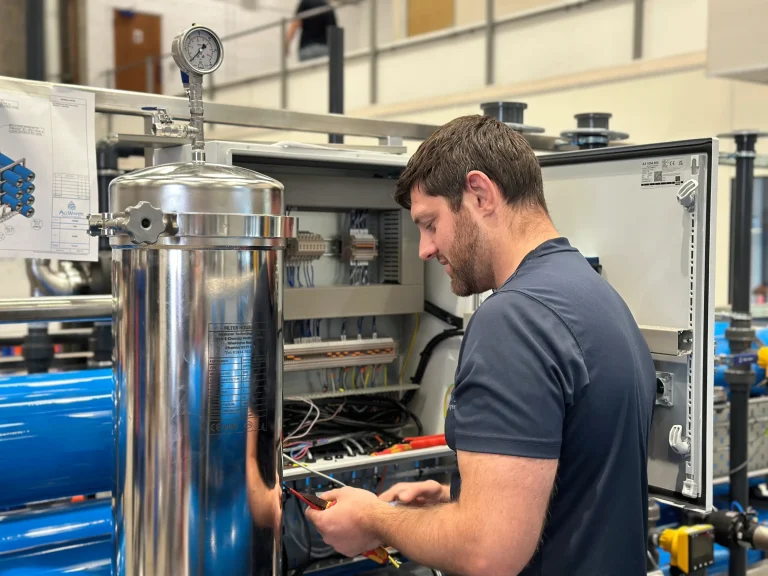
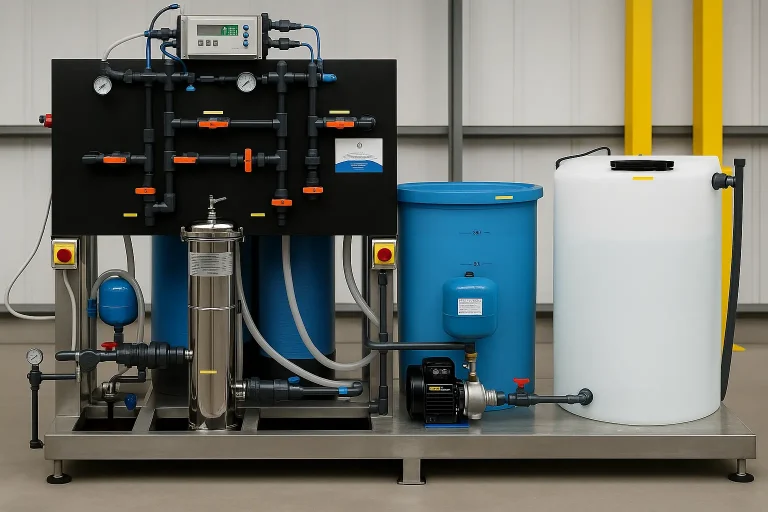
Our Technologies for Removing Contaminants from Water

The ongoing problem of how to deal with wastewater from industrial practices is a modern, man-made problem that requires complex and wide-ranging solutions.

At AllWater Technologies, that’s exactly what we provide our clients: cost-effective, responsible and sustainable wastewater treatment systems using the latest in technology.

In Part 1 of our series on wastewater treatment, we covered the most common and problematic contaminants that we remove for our clients across a range of manufacturing industries. Here, in Part 2, we delve into the kinds of technology we employ in the intelligent solutions we deliver.

State-of-the-Art Bespoke Solutions

From the smallest job to the largest and most complex industrial water treatment system, AllWater’s more than fifty years of experience allows us to identify exactly what our clients need. We work closely with them at every stage to ensure that the solutions we provide are not only the most effective, but also the most appropriate for them in terms of budget, operational requirements, flexibility and compliance. 

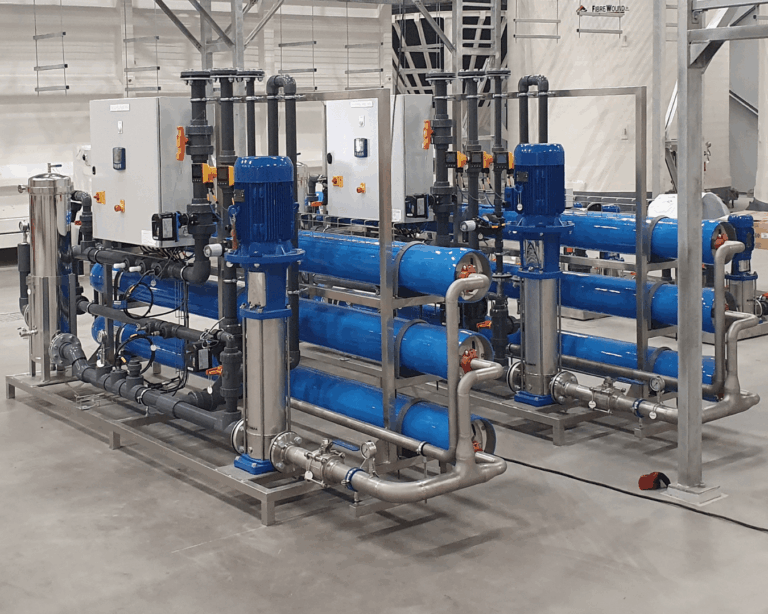
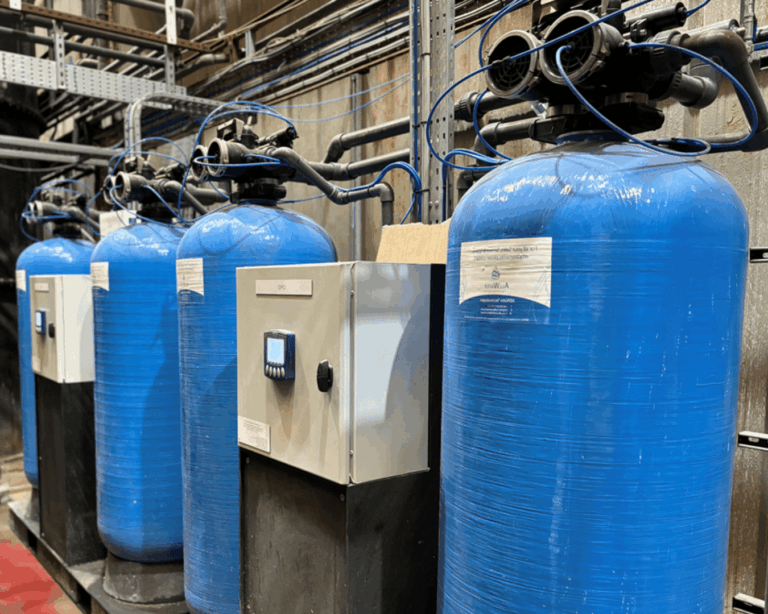
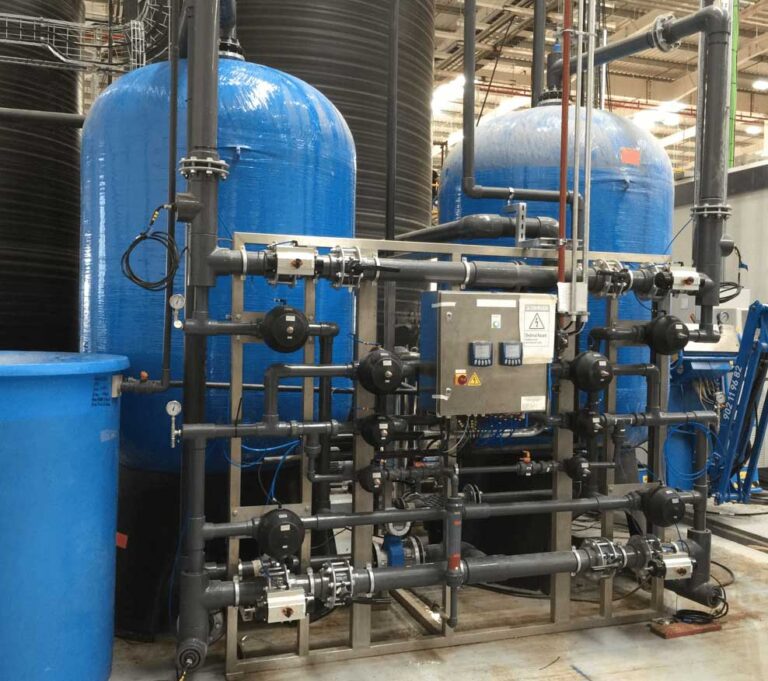
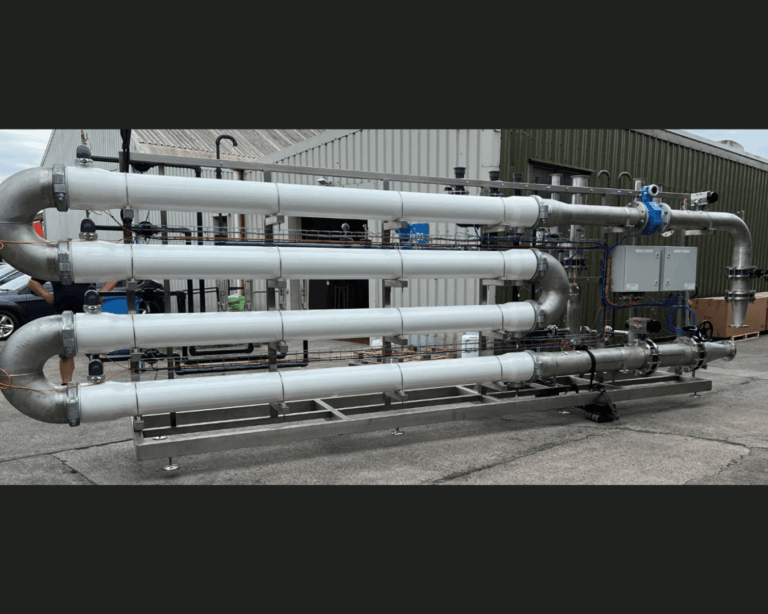
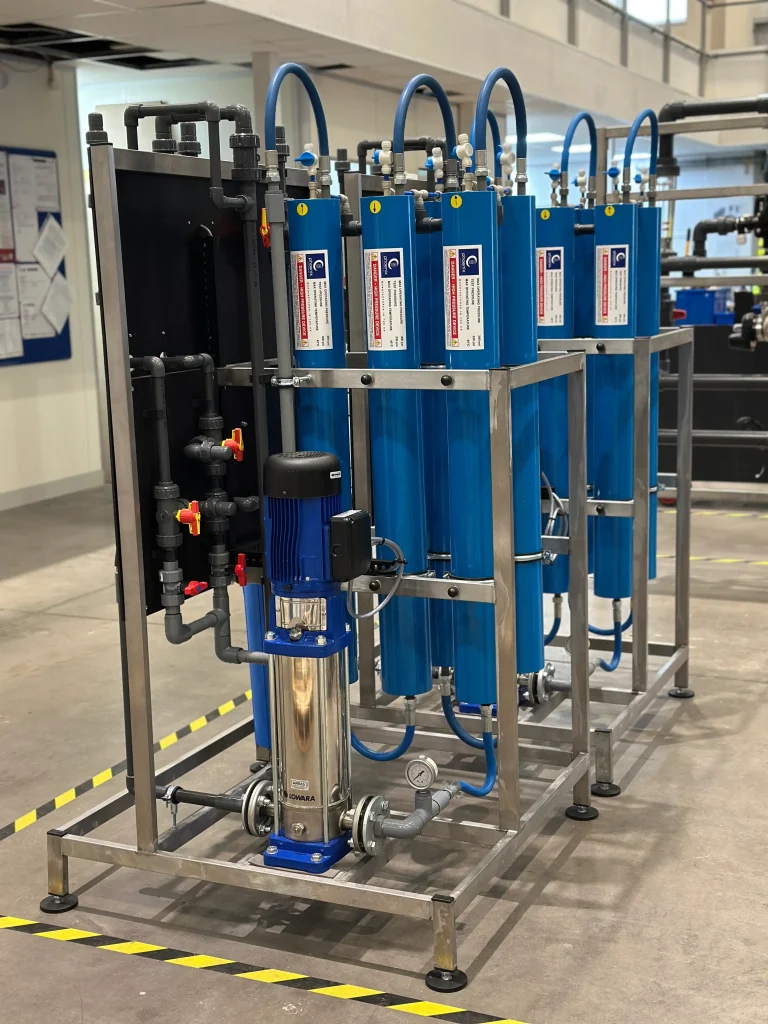
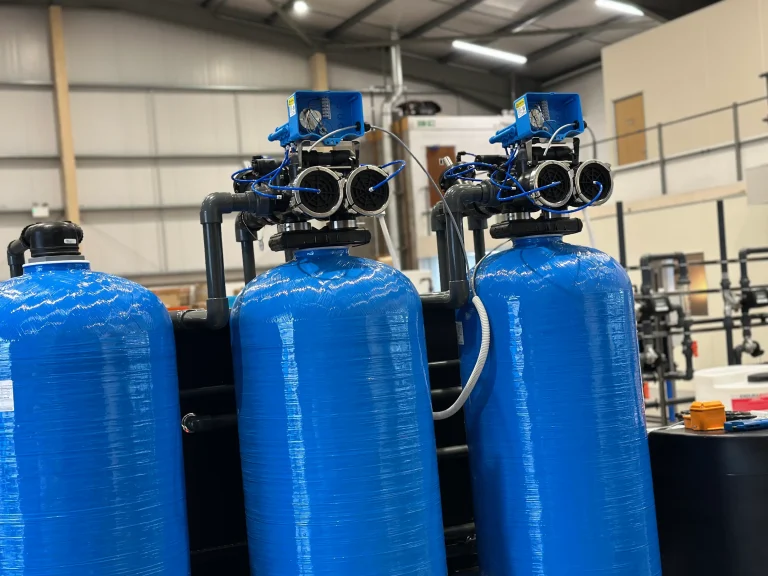
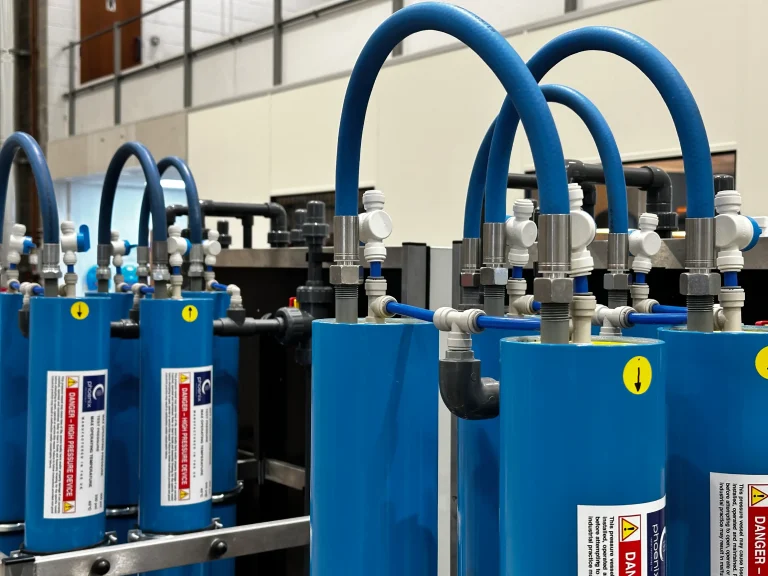
With many years of expertise, we utilise a broad spectrum of state-of-the-art technology and equipment to remove the vast range of chemical contaminants produced as industrial waste. Below we detail the most effective and sustainable solutions we use for our clients. 

Chemical Reaction Vessel

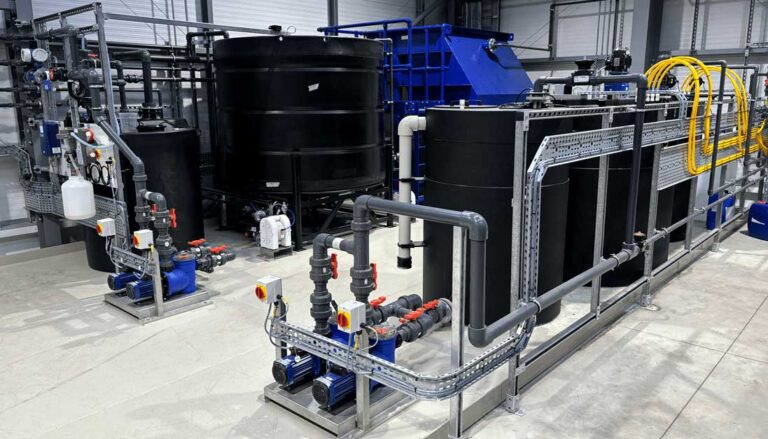
Reaction vessels form an integral part of many wastewater treatment systems and we use them in a variety of the processes we employ for our clients, including:
  • Cyanide oxidation
  • Chrome reduction
  • pH correction
  • Precipitation
  • Sulphate removal
  • Phosphate removal
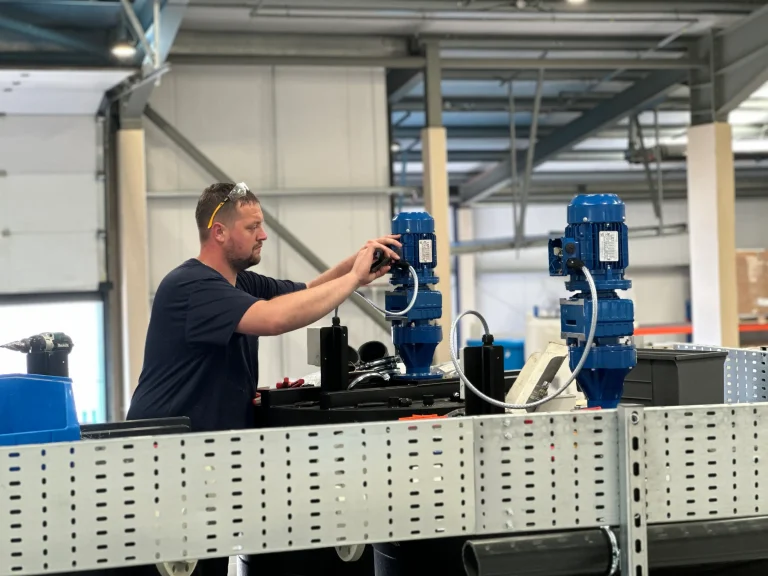
Over many years designing practical, flexible solutions, our experience has shown us that the most important consideration when installing a suitable reaction tank is ensuring homogeneous reaction conditions are maintained at all times. In order to do this, it is necessary for us to employ the correct method of mixing, which most often is an electrically powered mechanical stirrer.It’s very important that the impellers (the rotating part) on the stirrer provide an adequate level of mixing but without cavitation. In order to assist in this, we may position the stirrer offset to the centre of the tank and, additionally, we may employ baffles as part of the tank itself.Other aspects that we consider on a case-by-case basis for our clients include:
  • Size
  • Construction
  • Flow
  • Positioning
If a mixer is not adequately sized or the reaction tank design is poor, there is the danger in some instances that solids may build up at the bottom of the reaction tank leading to unnecessary maintenance requirements.

At AllWater Technologies we always carefully consider the construction materials for the tank and stirrer to ensure they are appropriate for the client. For example, for a reaction tank operating at low pH containing a high level of chlorides or even sulphates, it may be necessary to employ a mixer with a shaft and impeller that are suitably coated to offer chemical resistance.  

We also consider flow through the tank, to ensure that any reagent dosed adequately contacts the waste being treated. For example, if the waste water inlet and outlet of a reaction tank are both at the top, and mixing is not adequate, then there is danger that any chemicals dosed onto the top of the tank will immediately flow straight out without adequately contacting the waste. To this end, our reaction tanks are often designed so that the waste enters at the top but exits from the bottom. Where we employ a riser tube to assist in this, we ensure that there is no chance of syphoning forward from one tank to another.

When designing bespoke systems for a client we also very carefully consider the positioning of instruments within a reaction tank. Where the instrument is contacting the waste in order to provide measurement, we make sure it is suitably submersed so that our clients can gain consistent readings. For example, we would never install a pH probe immediately adjacent to an injection of acid or alkaline reagent but within the homogenous body of water. Where any instrument is likely to require regular maintenance either for cleaning or calibration, we give special consideration to ease of access and removal. 

When we employ flocculation (the addition of a reagent to aid aggregation of smaller particles in order to assist in their removal) in our clients’ wastewater treatment systems, it is usually carried out in a reaction tank or flocculation chamber. Again, we often use a stirrer to ensure adequate contact of the dosed chemical with the waste water. However, in that instance we take great care to ensure that whilst mixing is vigorous enough to prevent solid settlement within the reaction chamber itself, it is not too vigorous as to provide a shearing force that would break up the flocs themselves. To this end we often employ gearing to ensure that the tips of any impellers operate at very slow speed.   

When we design a system for a client that requires pumping waste containing solids into a settlement or flotation vessel, in-line flocculation may be employed after the pump, so that any flocs that might be formed are not broken up by passage through the pump. In this instance, we may use an in-line static mixer – which is designed to create a high level of turbulence within the pipe, without being excessive enough to break down any newly formed flocs – to provide the dynamic energy required for homogenous mixing.

Because AllWater’s clients come from a range of different industries with different needs, we use various types of settlement tanks for the removal of solids that have a tendency to sink rather than float.
  • A ‘Dortmund’ type settler is a vertical cylindrical tank with a conical bottom. Water enters the tank via a stilling area in the centre before passing down and exiting the stilling pipe near the conical bottom of the tank. From here the waste rises back up through the tank at low velocity, before exiting via a peripheral weir at the top. We ensure that the design velocity up through the tank is such that it is lower than the velocity at which solids drop through the water column. Solids then collect in the conical bottom of the tank before removal for further treatment or offsite disposal.
  • Tilted plate or lamellar type settlers employ a series of plates installed at an angle within a tank to increase the projected surface area. Similar to the Dortmund clarifier, water enters near the bottom before passing up through the tilted plate area. Solids falling out of the water column have a relatively short distance to travel before contacting the plates, where they join with other solids before sliding off into the sloping base of the tank. Like the Dortmund clarifiers we use in our wastewater treatment systems, from here the solids can be removed for disposal or further treatment.
In our systems that use a filter press, sludge from a settlement tank is pumped in under pressure and cloths fitted inside the chambers trap the solids, allowing the filtered waste water to exit the press.
  • The number and size of chambers within a press can vary typically between 10 – 90 chambers, and anywhere from 270ml square plates to upward of 1200ml.
  • The chambers are generally between 25 – 30ml deep, depending upon the nature of the waste to be filtered.
  • The chambers are sealed together by endplates and a hydraulic ram to ensure that water does not seep out between the plates.
  • We can individually port filter press plates, meaning that any filtered water comes out from a particular plate or can be internally ported where the filtrate exits via a number of common ports.
  • Depending upon the nature of the solids and the operating pressure of the press and feed pump, the solid content of the filter cake can vary, but a range of 25% – 35% solids is typical.
  • The cloths are generally constructed from a material such as woven polypropylene and must be regularly cleaned to prevent the weave becoming blocked, which can result in long filtration times and poor filter cake solid content.

Get in Touch with AllWater Technologies

We’re here to help with all your water treatment needs. Whether you have questions about our services, want to discuss a project, or need support, our team is ready to assist you. Fill out the form for general enquiries, or you are welcome to email direct or give us a call.

AllWater House

Unit 2,

Cheddar Business Park,

Wedmore Road,

Cheddar

BS27 3EB

Opening hours

Mon-Fri: 08:30-17:30 (GMT)


    AllWater Technologies: Our Journey, Growth, and a new chapter

    From Rants to Revenue: How One Angry Call Launched a Business

    They say opportunity knocks, but in my case, it shouted down the phone at me. Loudly.

    I was out for a walk, enjoying my newfound freedom after leaving my previous company a few months earlier, when my phone rang. The person on the other end? A very, very unhappy former client. And by unhappy, I mean the kind of furious that makes you hold the phone slightly away from your ear for safety reasons.

    After an eternity of ranting (and me wondering if I should fake bad signal), they paused for breath and I was able to calmly inform them that I was actually no longer the MD of the company they were furious with. Cue an awkward silence. Then, surprisingly, an apology from them. And just before hanging up, they let me with this lasting comment: “If you set up your own company, I’ll be your first client.”

    Initially, I laughed at the idea, but it was this one angry phone call that led to AllWater Technologies being born.

    And Then There Were Three

    A few days later, still amused by Mr Angry’s phone call, I found myself recounting the story to Sue Fisher and John Nicholson, two former colleagues. The three of us jokingly tossed around the idea of starting our own company-after all, we already had a guaranteed first client.

    Despite the thought of the three of us starting a business as a joke, it stuck with me and I realised that maybe it wasn’t such a bad idea after all. I reached back out to Sue and John and luckily for me, they were interested in making this wild idea a reality. The timing was right and we didn’t have much to lose. So in February, 2012, Sue and John officially joined me, and together, we took the plunge.

    Naturally, our first call was to Mr. Angry-and true to his word, he became our first client.

    Our spur-of-the-moment decision to start a business meant we weren’t exactly prepared for launching a business. We soon found ourselves scrambling for business, reaching out to old contacts, and figuring things out as we went. Just like Mr Angry, many of our former customers who had come to trust us over the years, chose to follow us into our new venture because they valued our expertise, industry knowledge, and commitment to service excellence.

    Being completely unprepared for rapid growth, we were all working from home offices and relying on using friendly supplier premises when having to build small plants. It wasn’t exactly a well-oiled operation, but it worked – until, six months in, we landed our first big order – over £300,000 – to supply capital plant in South Africa. This was a pivotal moment, proving that clients trusted us to handle large-scale, complex projects. But to deliver at extremely high standards, we needed a proper facility.

    Cue the scramble to find a proper facility. It was Sue that eventually found Unit S2, Mendip Business Park, Rooksbridge, a 1,935 sq ft unit – which became our very first home and which we subsequently purchased in 2014.  

    Given that the premises had previously been used for storing horse food, the entire unit stank horrendously of garlic. It was initially unusable as a workspace and Sue rallied  her family to roll up their sleeves and to give it a lick of paint. After their hard work, we suddenly had an operational workspace complete with a small office we could all work from and a rickety mezzanine floor that wobbled just enough to keep us on our toes.

    Soon enough, we managed to complete and ship our first major order to South Africa on time. John then duly made the trip to oversee the installation and commission the plant. Despite our unpolished beginnings, we were already proving ourselves as a serious player in the industry.

    As business quickly picked up, we soon found ourselves flat out with service clients and project work. Working frantically in the background, Sue collaborated with an external designer to develop and trademark the teardrop logo we still proudly use today. Alongside our new identity, we launched our very first website in September 2012, marking a major milestone in our company’s journey.

    By January 2014 it was clear we needed help with on-site service work. That’s when we welcomed our first employee and a familiar face. Roger Drew who had worked with us at a previous company, and – testament to his dedication, is still with us today. The same can be said for Jeanette Bishop, who joined us in September 2014 as our first office team member to keep things running smoothly. and who we’re very happy to say is still with us today.

    Our business continued to grow and in 2015 we bought another, smaller unit, D3 to provide additional build space of 1,600 sq ft and support our fledgling “cylinder exchange” business. As our team continued to grow, so did our need for office space and by 2017, we expanded within our original Unit S2, adding a dedicated kitchen area and first-floor offices. 2017 also saw us secure our first capital project order > £1m. In 2018, bursting at the seams once again, we sold D3 and purchased the adjacent unit S3, knocking through the wall to form a combined ground floor area of 4,845 sq ft giving us the room we desperately needed to keep up with demand.

    During this time our team grew significantly, and we now had a dedicated sales executive, additional field-based technicians to support our growing list of service clients, and also more office staff to handle administrative support to our burgeoning number of projects.

    Fast forward to 2022, and we expanded once again – adding another mezzanine area to Unit S3, to support our growing internal service admin team. Shortly after, we hit a major milestone, securing our first capital project order exceeding £2m and surpassing combined sales of £10m for the first time.  

    We also welcomed Stuart Howe, who joined as Director of Controls and Automation and is now leading our Projects and Production division.

    At the end of 2024, we completed the purchase of AllWater House in Cheddar, marking a major, milestone for us, and more importantly, for our customers. With over 10,000 sq ft of dedicated space, this new facility will allow us to increase production capacity, enhance efficiency, and optimise operations, ensuring even greater reliability for our clients. By the end of March 2025, all production and administration will move to AllWater House, providing a more advanced and fully equipped base of operations.

    And we’re not stopping there, Winterstoke House, offering an additional 6,500 sq ft gives us room to grow even further in the future, ensuring we continue to invest in new technologies and expand our capabilities to meet the evolving needs of our clients. 

    Of course we couldn’t have achieved any of this without our dedicated team, whose expertise and hard work have driven our success. But most importantly, we wouldn’t be here without our incredible customers, who continue to trust us with their critical water treatment needs. We are committed to expanding, innovating, and improving – not just for ourselves, but to better serve you for many years to come.

    Get in Touch with AllWater Technologies

    We’re here to help with all your water treatment needs. Whether you have questions about our services, want to discuss a project, or need support, our team is ready to assist you. Fill out the form for general enquiries, or you are welcome to email direct or give us a call.

    AllWater House

    Unit 2,

    Cheddar Business Park,

    Wedmore Road,

    Cheddar

    BS27 3EB

    Opening hours

    Mon-Fri: 08:30-17:30 (GMT)