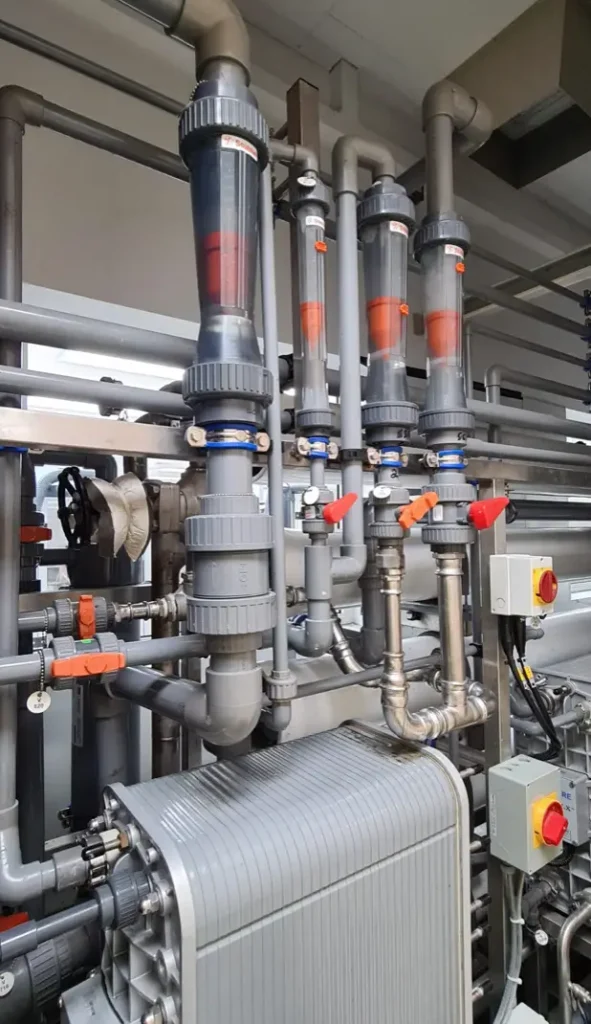
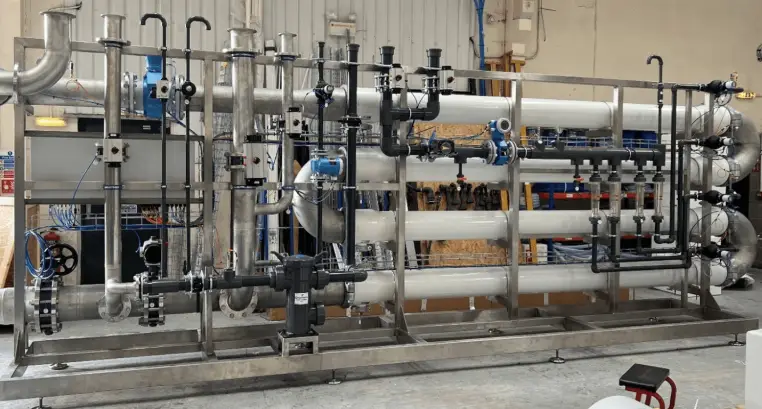
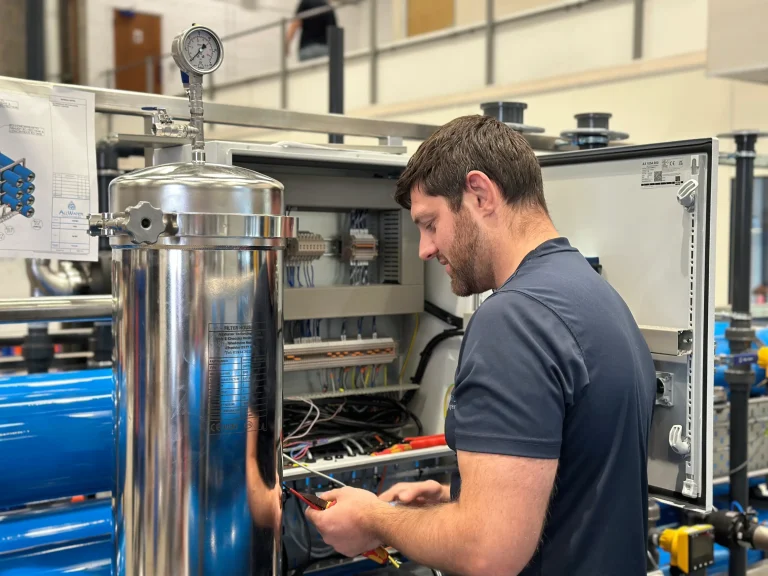
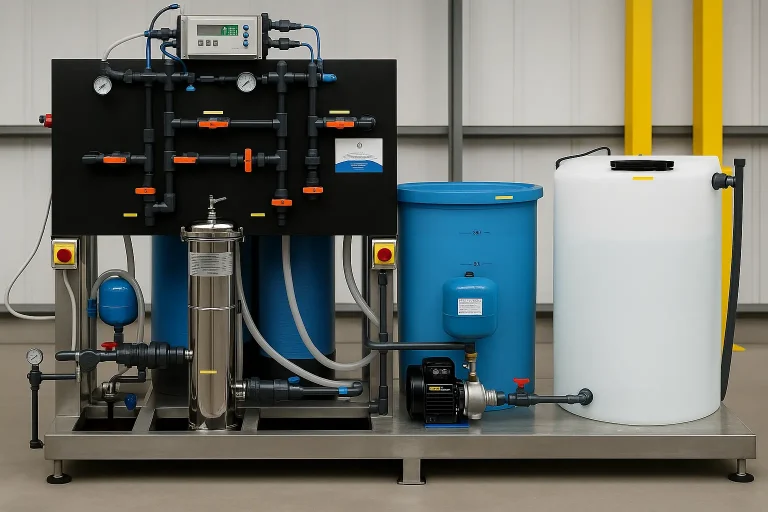
The treatment of water quality so it meets process needs. This can mean removing impurities prior to use in process or removing contaminants prior to discharge to drain. Core methods include RO, ion exchange, filtration, softening, ultrafiltration, EDI and wastewater treatment.
Match your incoming water to the quality you must achieve. Selection depends on feed analysis, target specs, flow and demand, running costs, footprint and utilities. AllWater reviews these factors and recommends the most reliable, cost effective option.
Yes. We design and build to your quality targets, flow, layout, utilities and controls. Options include materials, skid layout, PLC integration, redundancy, hygiene features, remote monitoring and containerised builds.
Yes. Designs follow relevant UK regulations and standards for each application, including Water Supply Regulations, HSE guidance such as ACOP L8 where applicable, UKCA or CE conformity, pressure equipment rules, BS EN electrical standards and WRAS components where required. We also design to meet site discharge consents.
Manufacturing, food and beverage, pharma and life sciences, healthcare, electronics, metal finishing, automotive, aerospace, energy, labs, chemicals, utilities, data centres and education. If your sector is not listed, we can still help.
Recent feed water analysis, target product water quality, flow rates and demand profile, a brief process description, site constraints and available services, control and integration needs, any materials or hygiene preferences, plus timeline and budget guidance. If you do not have a recent analysis, we can arrange sampling and testing.
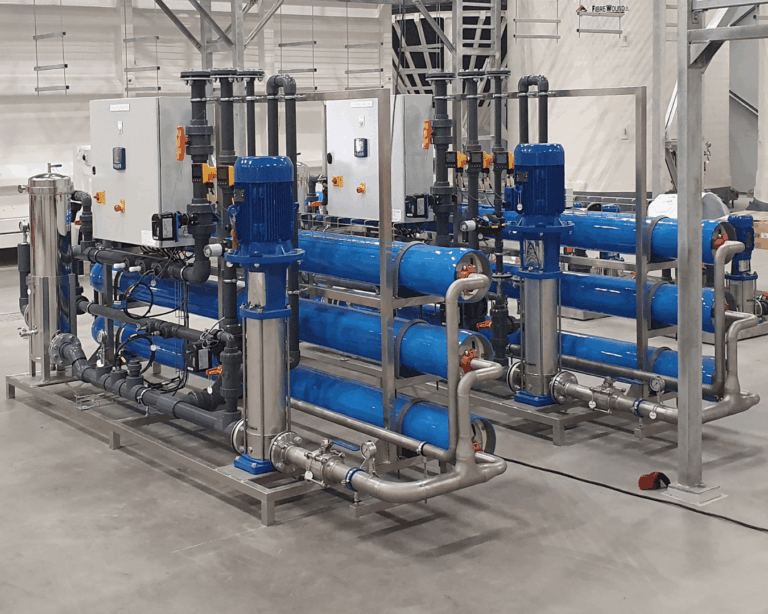
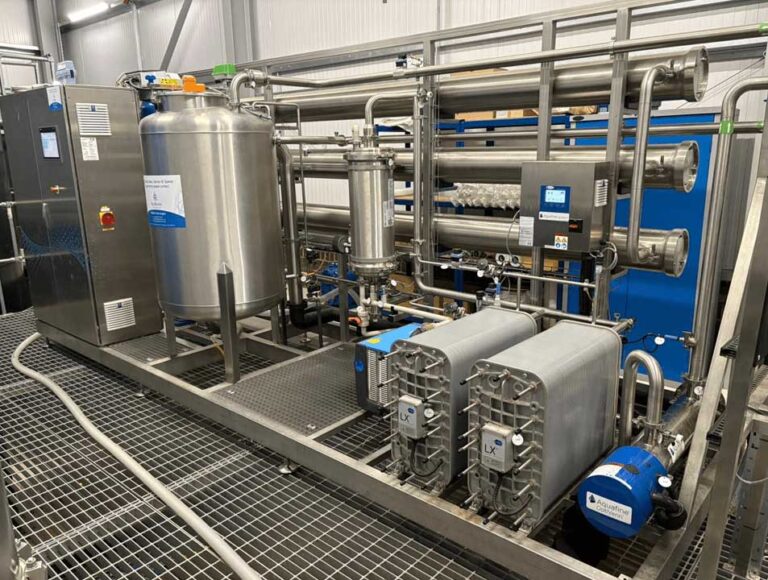
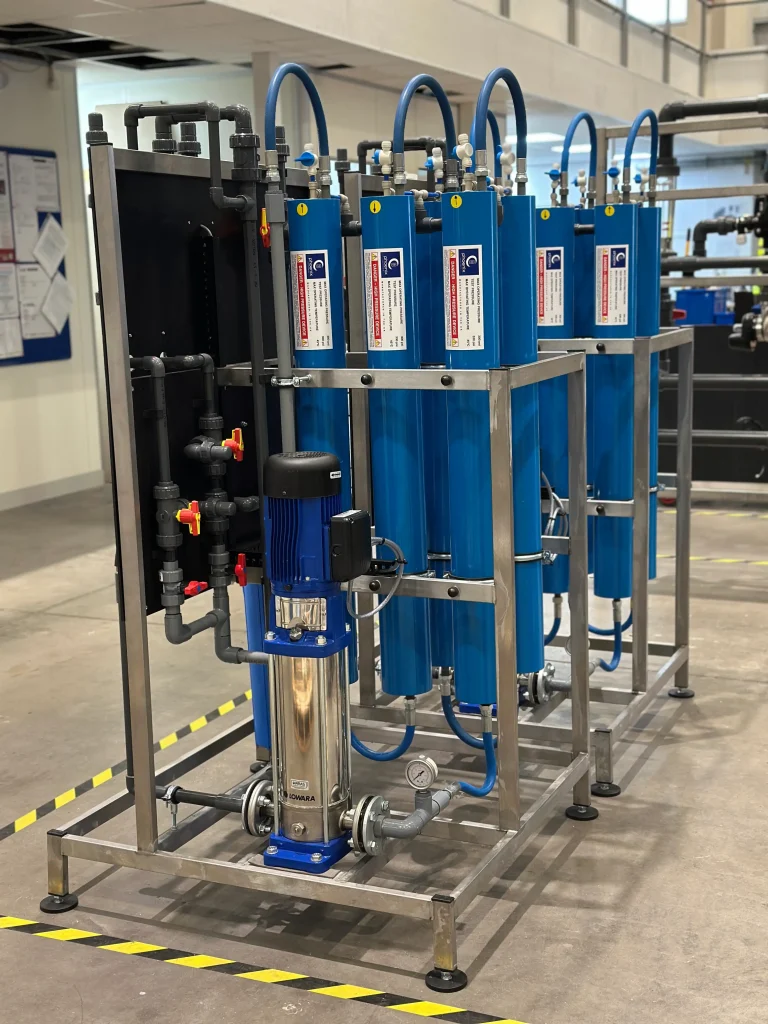
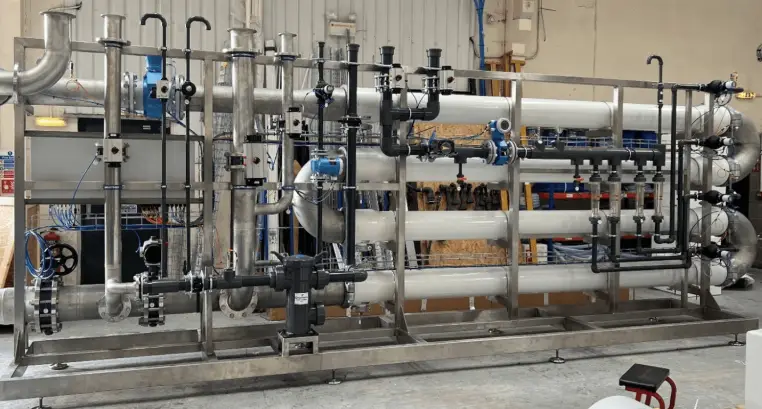
Reverse osmosis forces water through semi-permeable membranes at pressure, separating most dissolved salts, organics, and microbes from product water. The concentrated reject stream carries away contaminants; the permeate is the treated water.
RO significantly reduces dissolved salts and metals, nitrates, sulphates, silica, organic molecules, colour, and most bacteria and viruses. It is not a steriliser on its own, so high-purity systems often add UV or final filtration.
Typically 3 to 5 years in well run plants. Life depends on feed quality, pretreatment, flux and recovery settings, fouling or scaling rates, operating hours, and how routinely membranes are cleaned and sanitised.
Clean, non-oxidising feed with low turbidity and low SDI. Common pretreatments include multimedia or cartridge filtration, antiscalant or softening for hardness control, dechlorination with carbon or sodium bisulphite, iron and manganese removal where present, and pH control if needed. Stable pressure, temperature within membrane limits, and suitable drain capacity are also required.
Pharmaceuticals and life sciences, microelectronics, laboratories and healthcare, food and beverage, power generation and boiler feed, automotive and metal finishing, cosmetics, and general manufacturing.
The two terms are generally interchangeable and refer to removing minerals from water. “Demineraliser” is a term often used to describe a plant which uses ion exchange resins to remove the minerals. Other technologies can also be used to demineralise or deionise water, such as reverse osmosis or distillation.
Strong acid cation (SAC) resin to remove cations like calcium and sodium, and strong base anion (SBA) resin to remove anions like chloride, nitrate and silica. Weak base anion (WBA) may be used for organics and carbonic acid load reduction. Mixed-bed units combine cation and anion beads for final polishing.
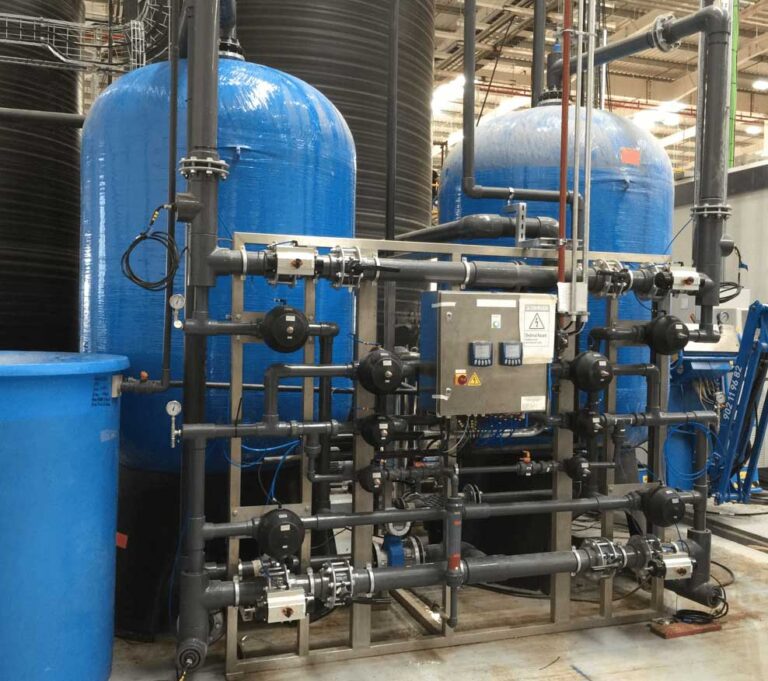
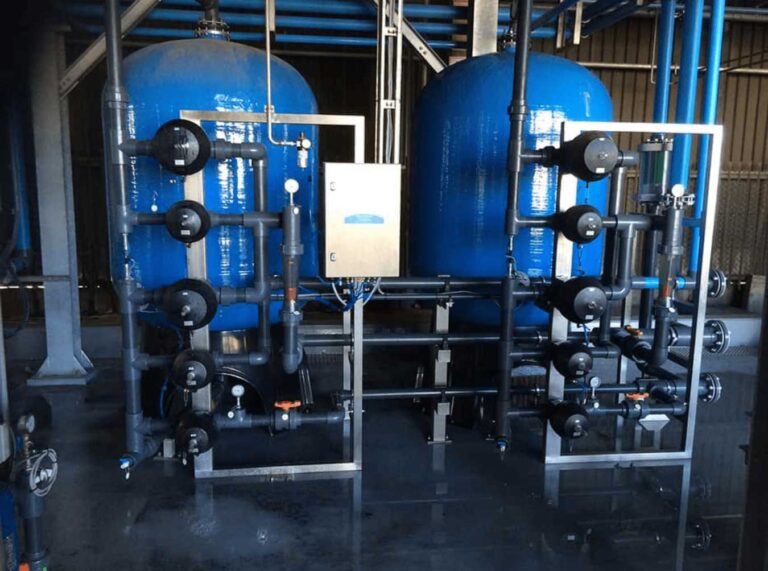
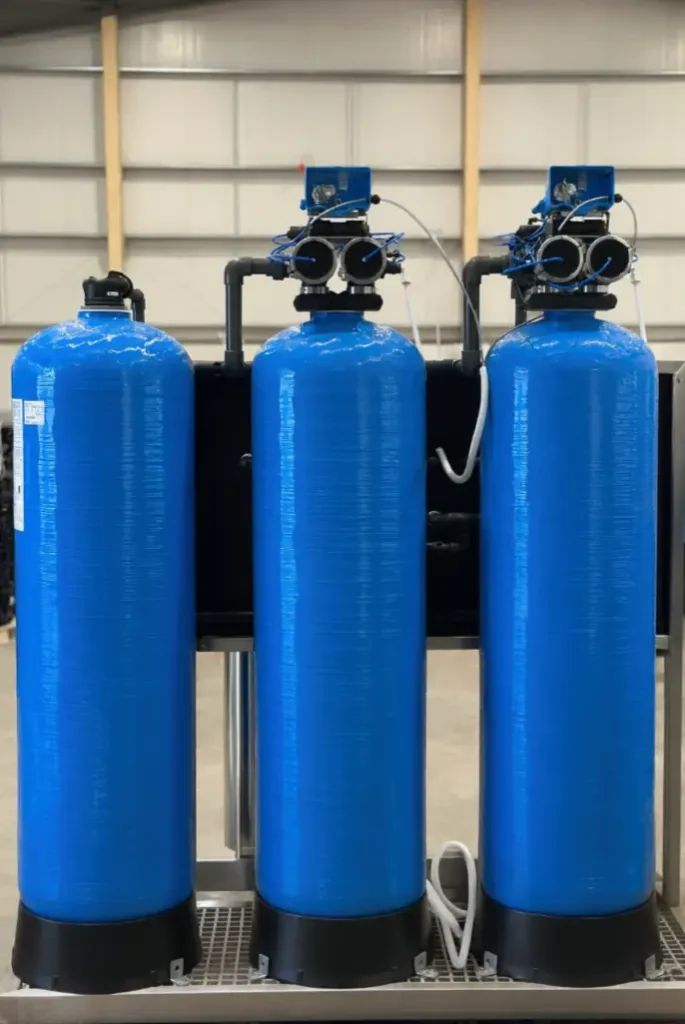
There are many different formats for producing deionised water using ion exchange resin. The most basic is co-current, twin bed design, where the cation and anion resins are held in separate vessels and the regenerant chemicals are drawn in the same direction as the service water flow, typically from top to bottom. In counter current units the regenerant chemical is drawn in the opposite direction to the service flow and treated water quality is improved. With a cation polisher this quality may be even better. If even better quality is required then a mixed bed unit may be the best solution. In this type of plant the cation and anion resin are held within the same vessel and mixed uniformly. This means that as water moves through the bed it is continuously polished, leading to an exceptionally high quality of treated water. Mixed bed units are also often employed after twin bed units for polishing, where ultrapure water quality is required.
It depends on feed quality, regenerant volume and concentration, bed size and service flow rate. Typical operation is measured in bed volumes. Regenerate when product conductivity rises, sodium or silica breaks through, or a set throughput is reached. Online conductivity and silica monitors guide the interval.
Cation resin is regenerated with acid, commonly hydrochloric or sulphuric. Anion resin is regenerated with sodium hydroxide. Standard steps are backwash, chemical injection, displacement, slow rinse and fast rinse. Chemical storage, dosing controls and PPE are essential.
Standard co-current, twin bed units quite be expected to achieve < 10 µS/cm, dependent upon incoming water quality. Counter current, twin bed units may produce treated water quality of < 2 µS/cm, sometimes lower with use of a cation polisher. “Roughing” mixed bed units may achieve < 1 µS/cm quality if used for polishing can achieve ultrapure water, up near 18.2 megOhm quality.
Calcium and Magnesium ions associated with scaling salts such as Sulphates, Carbonates and Bicarbonates.
Water passes through sodium form cation resin. The resin swaps sodium for calcium and magnesium. The resin is regenerated with brine (Sodium Chloride) to return the resin to the Sodium form and to restore capacity. Potassium chloride can be used where sodium addition is restricted.
Prevents scale in boilers, heat exchangers and RO plants, improves heat transfer, lowers energy and chemical use, protects equipment, reduces downtime, and gives consistent cleaning and process results.
Size for hardness load and peak flow. Key inputs are feed hardness, required flow rate, desired run time between regenerations, resin volume and service velocity. For 24/7 supply use duplex duty and standby. Allow for iron or manganese pretreatment if present.
Keep salt stocked and the brine system clean, check valves and injectors, verify hardness after the softener, and schedule periodic sanitisation and service. Inspect for channeling or resin fouling and replace resin when capacity declines. Annual servicing is recommended.
Ultrafiltration uses membrane pores to create a physical barrier to fine particles and microbes, giving consistent, low-turbidity water. Depth media and cartridges trap larger solids by interception and adsorption and are best for bulk or polishing duties.
Typically removes suspended solids, colloids, bacteria and most protozoa in the ~0.01–0.1 µm range. Many viruses are reduced but not guaranteed without additional barriers such as RO, UV or disinfectant.
Choose multimedia for variable or higher solids loads, larger flows and lower operating cost per m³. Use cartridges for low solids, polishing to a tight micron rating, small systems, or as final protection before membranes.
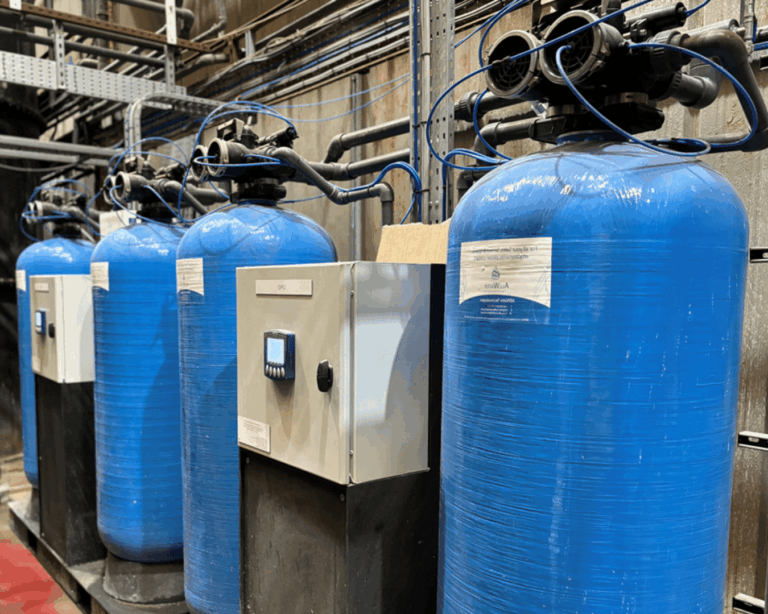
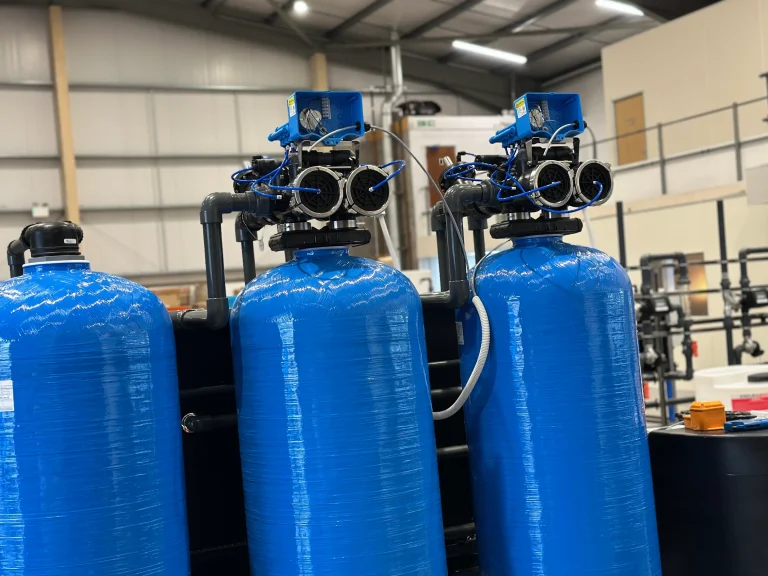
Multimedia filtration generally refers to particulate removal filters where a layer of anthracite is installed over a layer of sand to offer depth penetration and solids loading capacity, whereas the sand offers a final, polishing layover with little solids loading capacity.
It depends on the media. Replace when performance drops or capacity is spent, shown by rising pressure drop, turbidity breakthrough, or chlorine bleed-through on carbon. Typical ranges: turbidity media every 3–5 years, carbon 1–3 years, iron media 3–7 years, subject to loading and backwash quality. If used for organics removal then on exhaustion when total organic carbon (TOC) removal become ineffective.
Food and beverage, pharmaceuticals and biotech, municipal, wastewater reuse and recycling, microelectronics, metals and surface finishing, and general manufacturing.
A chemical-free polishing technology that uses ion exchange resins and membranes under a DC electric field to continuously remove dissolved ions from RO permeate. Ions migrate through selective membranes to a waste stream, leaving high-purity water.
Both produce very low conductivity. CEDI regenerates electrically, so no acid or caustic handling, no downtime for regeneration, and steadier quality. Mixed bed can tolerate more variable feeds and is simple to service but needs chemical regenerations and produces waste regenerants.
When you need continuous high purity after RO without chemical regeneration, typically for pharma, life sciences, microelectronics, power and laboratory make-up. It is ideal where consistent resistivity is required and feed is stable.
With suitable RO feed, CEDI typically delivers ≤0.1–0.2 µS/cm (5–10 MΩ·cm) and, in well designed systems, up to 0.0625 µS/cm (16 MΩ·cm) with very low silica and CO2. Actual results depend on feed quality, temperature, and system design.
Routine checks on inlet quality, flows, voltages and alarms, periodic sanitisation or cleaning as recommended, and keeping pretreatment (RO, carbon, softening or antiscalant, filtration) in good order. Modules are replaceable when performance declines, typically after several years of service.
Start with a representative analysis and flow profile. Match treatment to the contaminants and variability: pH neutralisation, oil and solids removal, coagulation flocculation with DAF or settlement, filtration or carbon, ion exchange or membranes for dissolved salts and metals, and biological steps for COD, BOD, ammonia or nutrients. Allow for equalisation, automation, sludge handling and future load growth.
Yes. With the right treatment and risk assessment, reclaimed water can serve washdown, cooling towers, irrigation, or even process make up. Typical trains combine solids removal, carbon, membranes such as UF and RO, and disinfection with UV or chlorine. Legionella control and documented hygiene plans are essential.
It very much depends on the waste stream, but may include elements of screening and equalisation, pH correction, chemical dosing for coagulation and flocculation, clarifier or DAF, sludge thickening and dewatering, media or cartridge filtration, activated carbon, biological treatment where required, and final disinfection. Instrumentation, PLC control, bunded chemical storage and sampling points are standard.
For discharge to sewer, a Trade Effluent Consent from your water company. For discharge to surface water or ground, an Environmental Permit under the Environmental Permitting Regulations from the relevant regulator. Waste sludge handling must meet Duty of Care requirements, and chemical storage must comply with COSHH. Site planning or building consent may also apply.
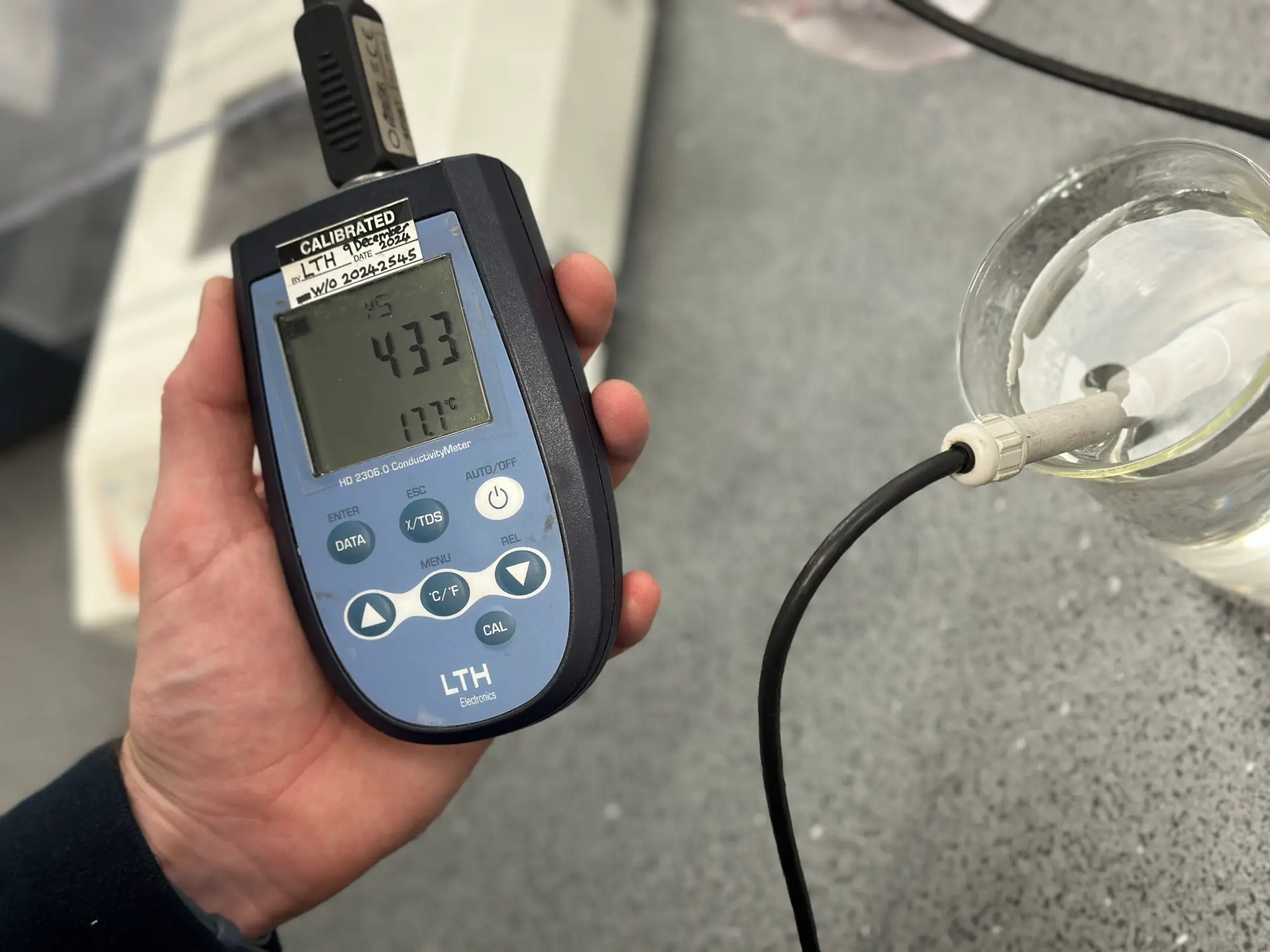
Combine online instruments and verified lab tests. Typical online parameters are flow, pH, turbidity, conductivity, temperature and sometimes ammonia, phosphate or TOC. Use calibrated meters, auto samplers for composite samples, routine lab analysis for COD, metals and microbiology, data logging, alarms and periodic MCERTS verified flow where required by consent.
The requirement to continuously monitor and record some parameters such as flow and pH is generally a requirement within the consent to discharge permit issued by your local water authority.
Flow (often MCERTS verified), pH, temperature, turbidity, suspended solids, conductivity, dissolved oxygen, ammonia, phosphate, TOC/COD surrogates, hydrocarbons, chlorine, and selected metals via periodic grab or composite samples.
It depends on your discharge consent or permit. Many sites are mandated to continuously log key parameters such as flow and pH, with specified accuracy, uptime, and data retention. Your permit sets what, how, and how often you must monitor.
The system raises alarms and can trigger automatic actions such as closing a valve or diverting flow to a holding tank. Operators investigate the cause, correct the issue, document actions, and notify the water company or regulator as required by the permit.
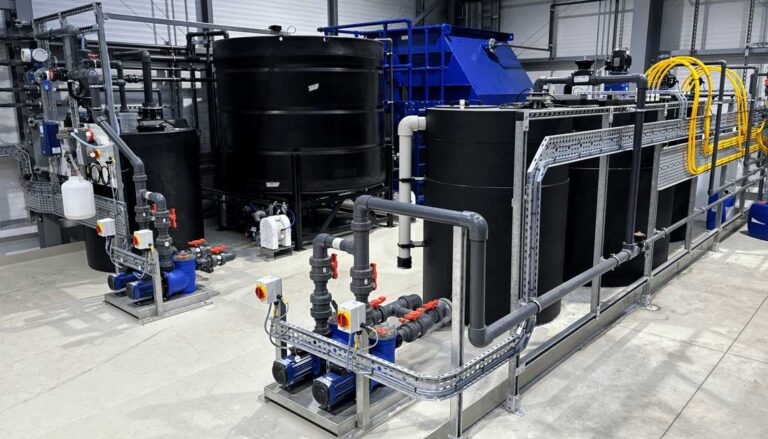
One piece and sectional GRP tanks, rotationally moulded polyethylene tanks, stainless steel process tanks, break tanks, header tanks, rectangular and cylindrical formats, insulated or non insulated, open top or closed with screened vents, with options for level control, heating, rodent screens and access hatches.
Yes, we supply WRAS approved tanks and fittings for potable water applications. Certificates and component datasheets can be provided on request and builds can be specified to meet Water Supply Regulations.
A tank or chamber with a calibrated V-notch measurement is used for MCERTS compliant measurement and recording of flow. Common uses include outfall monitoring, calibration of small treatment flows, equalisation overflow, and dosing control where a stable head and measured discharge are needed.
Yes. Integrally bunded tanks and external bunds are available, typically sized to at least 110 percent of the primary tank volume, with options for leak detection, high level alarms, vents and covered bunds for rain exclusion.
Yes. We supply metric and imperial pipework with BSP or NPT threads as required, plus flanged systems to PN and ANSI standards.
uPVC, ABS, CPVC, PE100, PP, PVDF, stainless steel 304 and 316, carbon steel and copper. Options include WRAS compliant components, hygienic tube, lined pipe, and insulated or heat-traced runs.
Yes. We design, fabricate and install to your layout, pressure and hygiene needs, including isometrics, supports, expansion control, valve automation, and pressure testing with full documentation.
Match fittings to chemistry, temperature, pressure, flow and standards. Select the connection type to suit build and maintenance needs, for example solvent weld, threaded BSP or NPT, compression, butt or electrofusion, sanitary clamp, or flanged PN16 or ANSI 150. Consider cleaning regime, regulatory requirements and available space.
A pressure vessel is designed to operate above or below atmospheric pressure and must meet Pressure Equipment requirements with reliefs and inspection. A tank is atmospheric or vented and follows different design rules for storage and break duties.
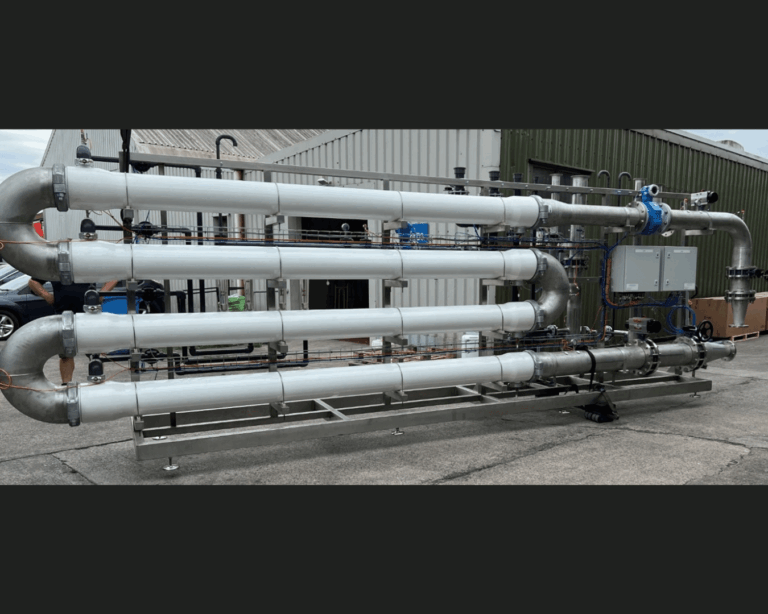
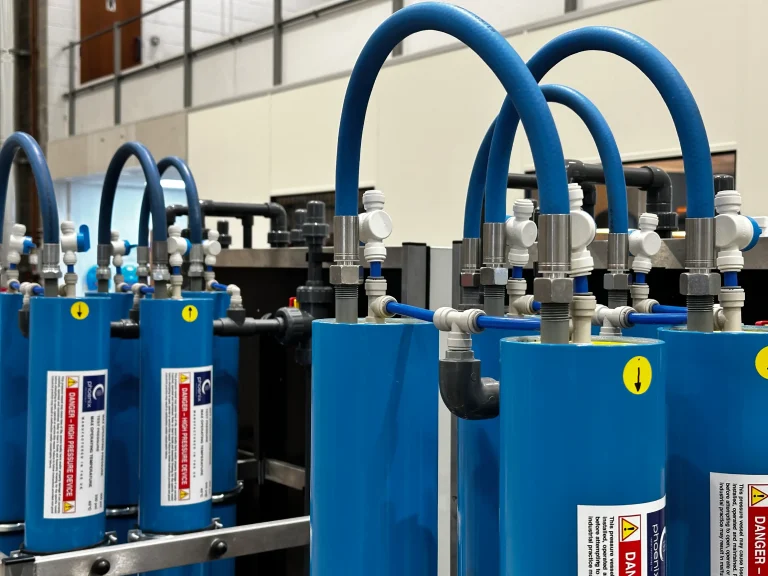
Common options are FRP/GRP composite membrane housings with stainless steel end hardware for most 4 inch and 8 inch RO arrays, and 316L stainless steel housings where higher temperature, hygienic service or aggressive cleaning is required.
Choose by membrane diameter and the number of elements per housing. Standard elements are 4 inch x 40 inch and 8 inch x 40 inch. Housings typically hold 1 to 6 elements for 4 inch systems and 1 to 8 for 8 inch housings. Above elements there is the danger of membrane compaction. Final selection comes from an RO array design that matches your flow, recovery, pressure and footprint.
Yes. We supply FRP composite membrane housings and FRP pressure filter vessels, with options for working pressure, end connections and regulatory compliance. WRAS compatible builds are available for portable duties.
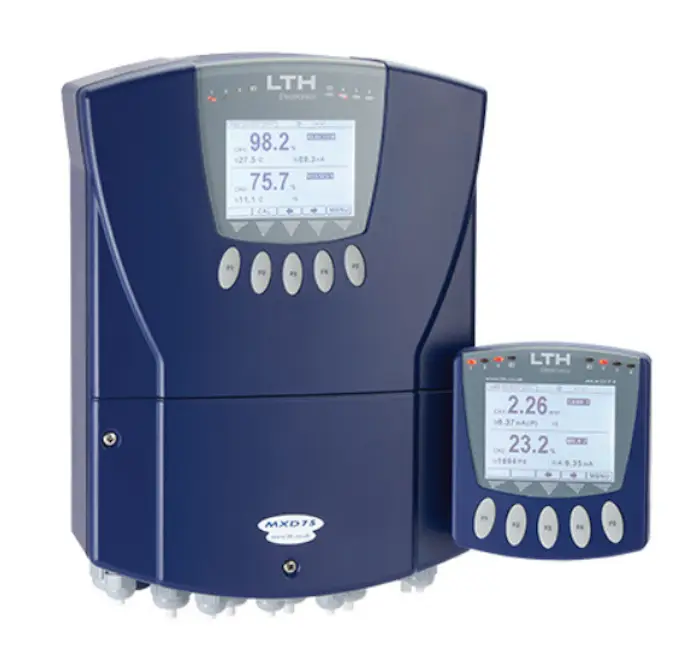
Online and portable meters for pH, ORP, conductivity, resistivity, turbidity, dissolved oxygen, temperature, chlorine and chloramine, UV254, TOC, ammonia, phosphate, nitrate, hardness, and flow including ultrasonic and electromagnetic. Samplers and level sensors are also available.
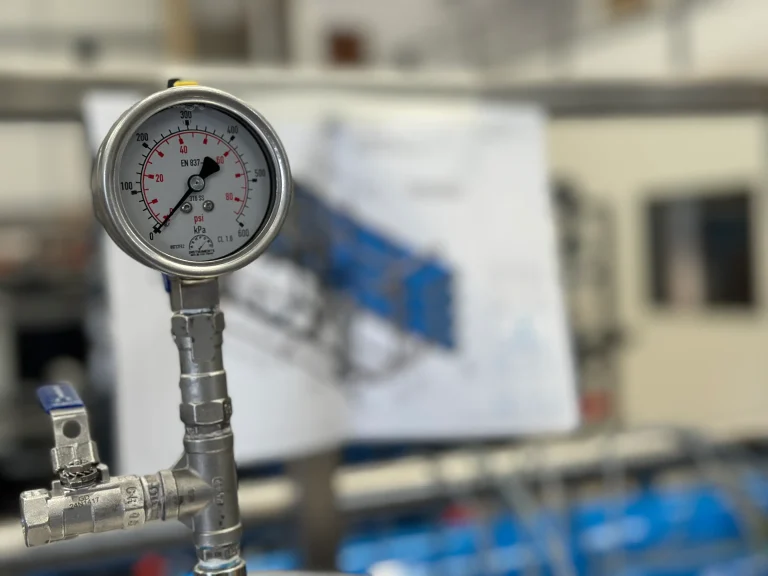
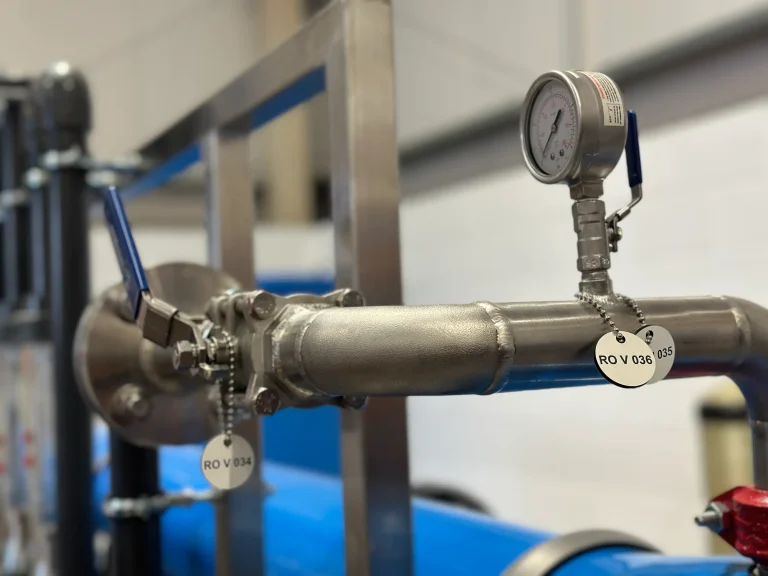
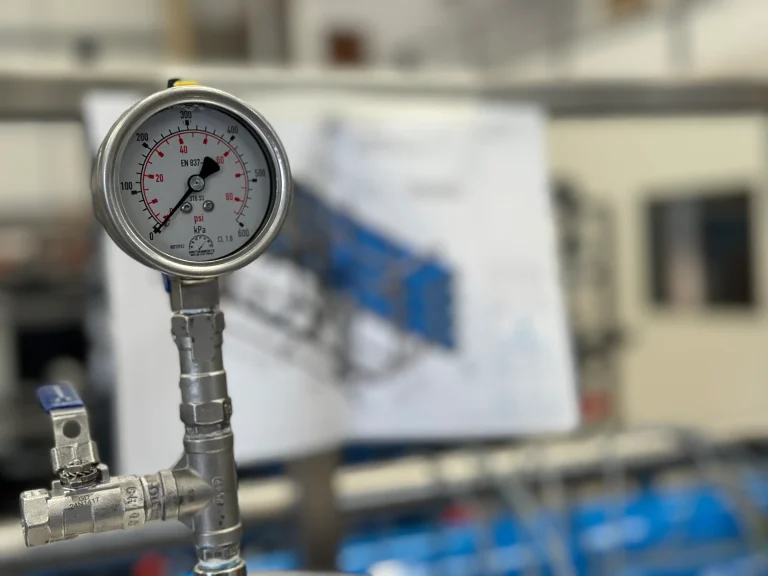
Industrial gauges typically offer class 1.0 or better for pressure and ±1 to 2 percent of full scale, and ±0.5 to 1.0 °C for temperature, depending on model. We specify accuracy, range, and compatibility to suit your process and compliance needs.
Yes. Outputs include 4 to 20 mA, HART, Modbus, Profibus, Profinet, and relay contacts. We supply transmitters, PLC panels, data logging, and secure remote access for alarm, trending, and reporting.
Routine calibration and validation, probe cleaning and replacement of consumables such as membranes, electrolyte, reagents, and desiccants. Keep sensors within operating ranges, verify with reference standards, and schedule periodic service and firmware updates.
Strong acid cation and weak acid cation for softening and dealkalisation, strong base anion and weak base anion for demineralisation, mixed bed polishing resins, plus speciality grades such as nitrate, organics, chelating, and low fouling resins.
pH correction media dissolve slightly to adjust water chemistry, typically raising pH and alkalinity using calcite or magnesia. Filtration media remove contaminants by physical capture or catalytic reaction, for example sand, anthracite, activated carbon or manganese dioxide.
Replace when performance declines or breakthrough occurs. Typical guides: activated carbon 1 to 3 years, turbidity media 3 to 5 years, iron and manganese media 3 to 7 years, softening resin 5 to 7 years. pH correction media are topped up regularly and fully replaced when depleted. Actual life depends on loading, backwash quality, oxidants, and fouling.
Yes. We assess feed analysis, targets, flow and temperature, oxidants like chlorine, fouling risks, and regulatory needs. We propose the most suitable media grade, bed depth, vessel size, and service conditions, with pilot testing if required.
Yes. UK wide call outs with phone support and remote diagnostics. We prioritise critical process and compliance issues and carry common spares to restore service quickly.
Planned maintenance visits, instrument calibration, checks on membranes and media, replacement of wear parts and consumables, checking of incoming water parameters such as total hardness and free chlorine, checking of treated water quality, checking of pumps and dosing pumps.safety and compliance checks, service reports, asset register updates, and priority breakdown response.
Yes. We service and upgrade most makes and models, adding compatible controls, instruments, and spares where needed.
It depends on duty, water quality, and compliance needs. Typical intervals range from quarterly to annually, with critical plants benefiting from monthly checks. We set a schedule based on risk and OEM guidance.
Yes. We supply new resin and media, handle removal and disposal under Duty of Care, rebed vessels, disinfect pipework, and commission the system with post change performance checks.
Water passes through resin beads that swap harmless ions for target metal ions. Strong acid cation or chelating resins capture dissolved metals. Once the resin is loaded, regeneration or recovery releases the metals to a concentrated stream for disposal or reuse.
Common targets include nickel, copper, zinc, chromium, lead, cadmium, cobalt, iron, manganese, silver and gold. Resin choice, pH and competing ions determine removal performance and selectivity.
Yes. We design trains using pH control, oxidation or reduction where needed, solids separation, ion exchange, and polishing filtration to achieve consent limits. We also provide monitoring, sampling points and documented procedures for compliance.
It depends on duty, water quality, and compliance needs. Typical intervals range from quarterly to annually, with critical plants benefiting from monthly checks. We set a schedule based on risk and OEM guidance.
Yes. We design, process and rinse water systems for machining, surface prep, anodising and change paint lines for plating, plus boiler and cooling water. Typical solutions include RO, DI or EDI polishing, pH correction, metals removal, and closed loop recycling with monitoring for consent compliance.
Hygienic RO with UV and final filtration for product and ingredient water, softening for utilities, carbon for taste and chlorine control, and CIP friendly layouts. We use WRAS compatible components where required and design for audit, traceability and low microbiological risk.
Yes. We supply RO and CEDI or mixed bed polishing with sanitary design, hot water or chemical sanitisation, 316L stainless distribution loops, and documentation for DQ, IQ, OQ, FAT and SAT. Monitoring can include conductivity, TOC and microbial controls aligned to pharmacopeial targets.
Rinse water production with RO and DI, metals removal and recovery on effluent, pH correction, chromium reduction where applicable, and closed loop rinse recycling. We also provide outfall monitoring, chemical storage, bunding and compliance reporting.
Yes. From boiler and cooling support to process water, filtration, softening, RO, DI, wastewater and reuse. We tailor plant to your analysis, flow, footprint and compliance needs, with service agreements and remote monitoring available.
P&IDs, process calculations, 3D models and general arrangements, isometric drawings, specifications, datasheets, control philosophy, I/O lists, wiring diagrams, manuals and spares lists.
Designs follow UK regulations and BS EN standards, including Water Supply Regulations, CE, UKCA, PED for rated vessels, electrical standards, and WRAS where required.
Yes. We survey tie-in points, match utilities and materials, and integrate controls with your PLC or SCADA using 4–20 mA, digital, Modbus, Profibus or Profinet. Phased installation and changeover plans minimise downtime.
Yes. Skid-mounted and containerised plants for fast deployment, factory FAT, small footprints and easy scaling. Layouts are optimised for access, hygiene and serviceability.
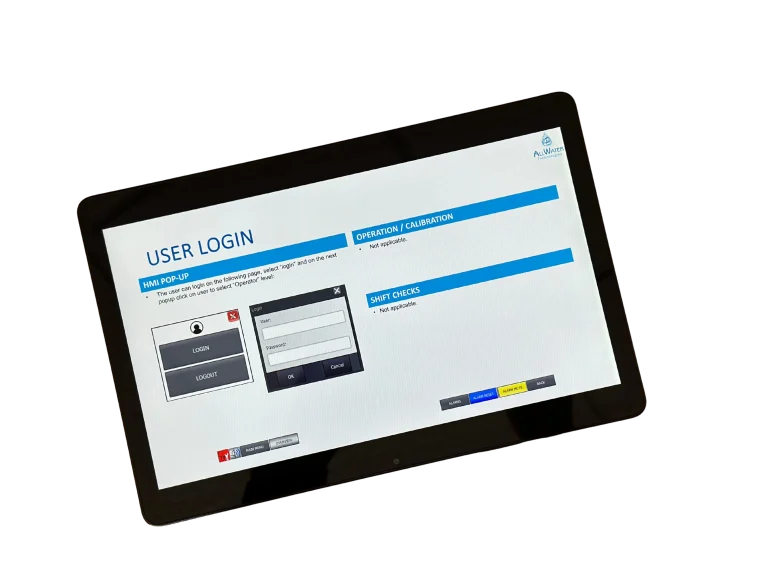
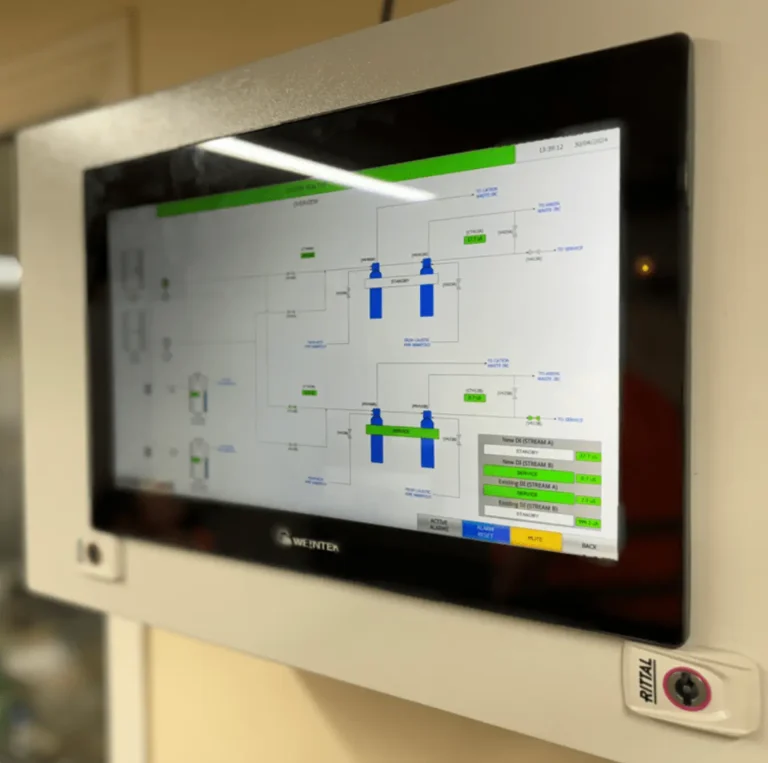
PLC and HMI panels, SCADA, telemetry, data logging, alarm management, remote access, and audit trails with user access controls. We align with site standards and provide full documentation and testing. We have in-house capability for programming PLC’s and HMI’s and that we work with Siemens, Allen Bradley and other major brands of PLC and HMI.
We’re here to help with all your water treatment needs. Whether you have questions about our services, want to discuss a project, or need support, our team is ready to assist you. Fill out the form for general enquiries, or you are welcome to email direct or give us a call.
Unit 2,
Cheddar Business Park,
Wedmore Road,
Cheddar
BS27 3EB
Mon-Fri: 08:30-17:30 (GMT)